
Sale and leaseback sounds simple.
A company owns an asset. It sells that asset to somebody else. It then leases the same asset back and continues using it.
Commercially, the appeal is obvious. The company can release cash tied up in property or equipment without necessarily giving up access to the asset it needs to operate.
Accounting for the transaction is less straightforward.
IFRS 16 has been in force for years, and the International Accounting Standards Board has now completed its post-implementation review of the standard. The overall conclusion is reassuring. IFRS 16 is broadly working as intended and has improved transparency around lease obligations.
Sale and leaseback, however, remains one of the areas where apparently simple transactions can create difficult accounting questions.
The challenge is not only calculating a lease liability. Management must determine whether a genuine sale has occurred, what rights have actually transferred, how much gain can be recognised, how the leaseback should subsequently be measured and whether other standards change the answer.
Recent IASB discussions have also kept attention on transactions involving single-asset companies and corporate wrappers.
For SBR ACCA candidates, this makes sale and leaseback a useful topic because it brings together IFRS 16, IFRS 15, IFRS 10, professional judgement and commercial substance.
Candidates developing this type of applied reasoning with an ACCA SBR tutor should focus on the sequence of decisions rather than trying to memorise one standard calculation.
Why companies use sale and leaseback arrangements
The commercial logic usually starts with cash.
Property can represent a large amount of capital sitting on a balance sheet. A retailer may own stores. A manufacturer may own factories and warehouses. A logistics business may own distribution centres.
Selling those assets can release substantial cash.
The business can then lease the property back and continue operating from the same location.
Management may use the proceeds to repay debt, fund an acquisition, invest in the business or improve short-term liquidity.
That does not automatically mean the transaction improves the underlying economics of the company.
The company has received cash, but it may also have committed itself to years of future lease payments.
The accounting therefore needs to show both sides of the transaction.
Users should be able to see that an asset has been transferred, that cash has been raised and that the company has retained a right to use some or all of that asset for a period.
This retained right is the reason sale and leaseback accounting is different from a straightforward disposal.
The first question is whether there was actually a sale
Candidates often jump straight to lease accounting.
That is too early.
The first question is whether the transfer qualifies as a sale.
IFRS 16 requires the entity to use the requirements of IFRS 15 when assessing whether control of the asset has transferred to the buyer.
This matters because legal ownership changing hands does not automatically prove that a sale has occurred for accounting purposes.
The substance of the arrangement must be considered.
If the transfer satisfies the IFRS 15 requirements for a sale, sale and leaseback accounting applies.
If it does not, the transaction is treated very differently.
The seller-lessee continues recognising the transferred asset because control has not genuinely passed. It also recognises a financial liability for the proceeds received.
The buyer-lessor does not recognise a purchased asset in the normal way. Instead, it recognises a financial asset representing the amount transferred.
That distinction can completely change the financial statements.
A good SBR answer therefore begins with the sale assessment.
Why the leaseback itself can affect the sale assessment
A company selling an asset and immediately leasing it back may appear to have transferred control while continuing to use exactly the same property.
That does not automatically prevent a sale.
The important issue is whether the buyer has obtained control of the asset even though the seller has retained a right to use it through the lease.
The leaseback represents a retained right of use. It does not necessarily mean the seller still controls the whole asset.
However, unusual contractual terms may indicate that control has not genuinely transferred.
For example, management should consider whether the seller effectively controls decisions about the asset beyond the normal rights of a lessee or whether other contractual arrangements substantially restrict the buyer’s ability to direct the asset.
Candidates should resist simple conclusions based only on physical occupation.
Continuing to sit inside the same building does not automatically mean the building was never sold.
The contractual rights matter.
A genuine sale does not create a normal disposal gain
This is one of the most important sale and leaseback principles.
Imagine a company owns a building and sells it at fair value.
If the company walked away completely, a normal disposal would generally remove the asset and recognise the resulting gain or loss.
In a sale and leaseback transaction, the company does not walk away completely.
It retains a right to use the building.
The seller-lessee therefore recognises a right-of-use asset representing the rights retained through the leaseback.
Because some rights have been retained, the seller cannot treat the transaction as though every economic right in the property has been transferred.
The gain recognised at the transaction date relates only to the rights transferred to the buyer-lessor.
This prevents a company from recognising a large disposal gain while effectively continuing to enjoy significant use of the asset.
That is a crucial economic point.
The accounting reflects the fact that the seller has transferred part of its interest while retaining another part.
The right-of-use asset needs careful measurement
At the date of the transaction, the seller-lessee measures the right-of-use asset arising from the leaseback based on the proportion of the previous carrying amount that relates to the right of use retained.
This is different from simply measuring the right-of-use asset at the entire lease liability.
The calculation is designed to separate the rights transferred from the rights retained.
Suppose a building has a carrying amount of £8 million before the sale. The company sells it for fair value and leases it back for a significant period.
Part of the previous carrying amount effectively relates to the continuing right of use. That portion remains within the new right-of-use asset.
The remaining portion relates to rights transferred to the buyer.
Only the gain relating to those transferred rights is recognised.
In an exam, the calculation may matter, but the explanation matters too.
A board should understand why the full disposal gain is not being recorded.
The company has sold the legal asset, but it has retained some of the economic benefit through the leaseback.
Off-market terms create another layer
Not every sale and leaseback takes place at fair value.
A company might sell an asset for more than fair value and compensate the buyer through higher future lease payments.
Alternatively, it may sell below fair value and receive cheaper lease terms.
IFRS 16 therefore requires adjustments where the sale price or lease payments are not at market terms.
If the sale price is below fair value, the shortfall may represent a prepayment of lease payments.
If the sale price is above fair value, the excess may represent additional financing provided by the buyer-lessor.
This is important because management should not be able to manipulate the apparent sale gain simply by changing the headline sale price and compensating through future rent.
The accounting looks through the commercial package.
That is a strong SBR point.
Do not analyse the sale price and lease payments independently when the terms appear unusual.
Ask what the overall transaction achieves.
Why subsequent measurement needed an amendment
The original version of IFRS 16 contained requirements for accounting for a sale and leaseback at the transaction date.
It did not provide sufficiently specific requirements for how the seller-lessee should subsequently measure the lease liability arising from some sale and leaseback transactions.
That created uncertainty.
The IASB responded by issuing a narrow amendment to IFRS 16 in September 2022.
The amendment, which applies for annual periods beginning on or after 1 January 2024, added subsequent measurement requirements for the lease liability arising from a sale and leaseback.
The aim was to ensure that the seller-lessee does not subsequently recognise gains relating to the right of use it has retained.
That principle is consistent with the initial accounting.
If the company retains a right to use part of the asset, it should not gradually create an artificial gain simply through the subsequent measurement of the lease liability.
For candidates, the wider lesson is important.
Sale and leaseback is not finished once the transaction-date calculation has been completed.
Subsequent accounting matters.
Variable lease payments can make the accounting less intuitive
Sale and leaseback arrangements may contain variable payments.
These can make subsequent measurement more difficult because the leaseback obligation needs to reflect the retained right properly.
The specific accounting can depend on the terms of the arrangement.
This is exactly why candidates should avoid approaching sale and leaseback as a memorised journal entry.
Start with the contractual facts.
What payments must the seller-lessee make?
Which amounts are fixed?
Which are genuinely variable?
What right has been retained?
How should the lease liability be measured so that no inappropriate gain is recognised on the retained right?
That reasoning is more reliable than trying to remember an isolated calculation from a model answer.
Sale and leaseback also changes how performance looks
These transactions can materially alter headline financial figures.
The seller receives cash.
The original asset is derecognised if the transfer qualifies as a sale.
A right-of-use asset is recognised.
A lease liability arises.
A gain may be recognised on the rights transferred.
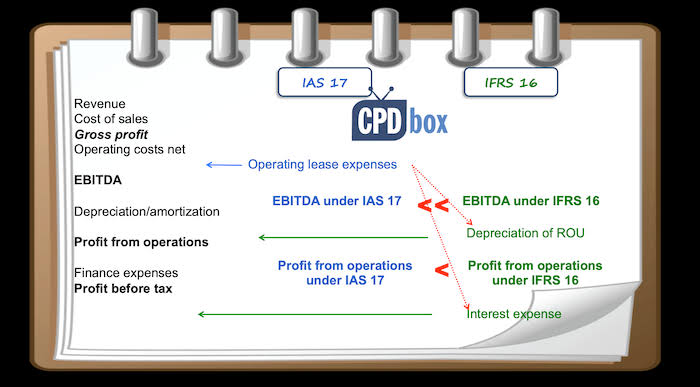
Future periods then contain depreciation of the right-of-use asset and interest on the lease liability.
That means performance before and after the transaction can look very different even though the company may still operate from exactly the same building.
This creates an important analytical issue.
Management might describe the sale as strengthening liquidity because cash has been released.
That may be true.
Investors should also consider the future lease commitments and whether the transaction has simply replaced property ownership with contractual payments.
A board-ready discussion should show both effects.
Cash flow presentation can tell another part of the story
Sale and leaseback transactions also affect cash flow analysis.
The sale can generate a substantial cash inflow.
Future lease payments then create cash outflows over time.
Looking only at the initial inflow may create an overly positive impression.
This matters because the IASB’s recent post-implementation review of IFRS 16 has highlighted wider interest in improving information about lease-related cash flows.
The Board has decided to explore, through its statement of cash flows project, whether lessees should provide clearer information about the components of total lease cash outflows and where those components appear in the cash flow statement.
For users, this could make the ongoing cost of lease arrangements easier to understand.
For SBR candidates, the lesson is straightforward.
Do not analyse a sale and leaseback only through profit.
Consider liquidity, future cash commitments and financing consequences as well.
The corporate wrapper problem is particularly interesting
A more unusual sale and leaseback issue arises when the asset sits inside a separate company.
Imagine a group owns a subsidiary.
That subsidiary owns one building and has no other significant assets or liabilities.
Instead of selling the building directly, the parent sells all of its shares in the subsidiary to a third party.
The parent then leases the building back.
Commercially, this may look very similar to selling a building and leasing it back.
Legally and structurally, however, the group has sold shares in a subsidiary rather than transferring the building directly.
This creates an interaction between IFRS 10 and IFRS 16.
IFRS 10 contains requirements for accounting when a parent loses control of a subsidiary.
IFRS 16 contains sale and leaseback requirements where an entity transfers an asset and leases that same asset back.
Which requirements should drive the accounting when the asset is wrapped inside a single-asset company?
That question has proved difficult enough to remain on the IASB’s radar.
What the IASB decided in 2026
The recent post-implementation review provides useful context.
In July 2026, the IASB concluded that IFRS 16 is overall working as intended.
That is important. The Board is not proposing to reopen the entire lease accounting model.
However, the sale and leaseback of an asset held through a single-asset entity remains a recognised corporate-wrapper issue.
The IASB decided that the specific matter should no longer sit separately in the maintenance project pipeline.
Instead, it plans to consider the priority of this issue together with other corporate-wrapper matters during its next agenda consultation.
That is a subtle but important distinction.
The issue has not been solved through a new accounting rule.
Nor has the Board concluded that every sale and leaseback question needs further standard-setting.
The broader question is whether transactions involving corporate wrappers create enough difficulty and diversity in practice to justify a larger project.
For current SBR candidates, this makes it a useful discussion topic but not a reason to invent a future accounting treatment.
Explain the current principles and acknowledge that the interaction remains an area under consideration.
Why corporate wrappers create accounting tension
Accounting standards generally focus on the substance of rights, obligations and transactions.
Legal structures still matter because standards apply to specific assets, entities and transactions.
Corporate wrappers sit directly between those two ideas.
Economically, selling a company that contains nothing except a building may appear similar to selling the building.
Legally, the transactions are not identical.
In one case, the asset itself is transferred.
In the other, shares in an entity are transferred and the parent loses control of that entity.
The accounting consequences can therefore depend on which standard applies and how those requirements interact.
This is a good example of why financial reporting cannot always be reduced to a simple flowchart.
Professional judgement is needed to understand the transaction before applying the technical requirements.
The post-implementation review did not find every sale and leaseback issue requires action
Another useful point from the IASB’s review is restraint.
Stakeholders raised questions about how IFRS 16 interacts with IFRS 15 when determining whether a transfer qualifies as a sale and when recognising gains or losses.
The IASB decided not to take further action on several of these matters.
That should stop candidates writing exaggerated current-issues answers claiming that sale and leaseback accounting is fundamentally broken.
It is not.
The IASB’s overall conclusion is that IFRS 16 is functioning as intended.
The stronger discussion is that some difficult areas remain, particularly where transactions interact with other standards or unusual legal structures.
That is a much more balanced answer.
Sale and leaseback can create governance issues too
A major sale and leaseback transaction should not be treated as an accounting exercise completed after management has agreed the deal.
The board should understand why the transaction is being undertaken.
Is the business genuinely releasing capital for productive investment?
Is it using the proceeds to reduce expensive debt?
Is the transaction necessary because the company is struggling for cash?
How long is the leaseback commitment?
What happens when the lease expires?
Are rental increases linked to inflation?
Does the company have extension options?
How does the transaction affect future operating flexibility?
These questions matter because a transaction can improve immediate liquidity while increasing long-term commitments.
A board that focuses only on the sale proceeds may miss the wider commercial effect.
The transaction should survive a simple economic test
A useful governance question is:
What has actually changed?
Before the transaction, the company owned the property and used it.
After the transaction, somebody else owns the property and the company pays for the right to continue using it.
Cash has been released.
Ownership risk has changed.
Future contractual commitments have been created.
Some rights have transferred and others have been retained.
That economic explanation should match the accounting.
If the financial statements appear to show a huge gain with little recognition of the retained obligation, the treatment deserves challenge.
If management describes the transaction as a simple property sale while committing the company to decades of rent, the narrative deserves challenge too.
Sale and leaseback can affect ratios and performance measures
Companies may be attracted to sale and leaseback partly because of the impact on financial metrics.
The transaction may increase cash.
It may change total assets.
It may create a gain.
It may affect measures based on operating profit, return on assets, leverage and cash flow.
Future depreciation and interest also change the pattern of reported expenses.
Management should therefore be careful when describing improved financial performance following the transaction.
Not every improvement in a ratio represents an improvement in the economics of the business.
Investors may want adjusted information that helps them compare the business before and after the deal.
SBR candidates should connect this to faithful representation and professional scepticism.
If management benefits from presenting the transaction positively, consider whether there is an incentive for bias.
What an audit committee should challenge
A substantial sale and leaseback should attract audit committee attention because several significant judgements may be involved.
A useful review should consider:
- whether the transfer genuinely qualifies as a sale
- whether the sale price and lease terms reflect market values
- whether any financing or lease prepayment has been identified
- how the retained right of use has been measured
- whether the gain relates only to rights transferred
- whether the subsequent lease liability follows the amended IFRS 16 requirements
- whether disclosures explain the transaction and future commitments clearly
- whether management’s narrative is consistent with the accounting and cash flow effects
The audit committee does not need to perform the calculations itself.
It does need enough understanding to challenge management’s conclusion.
That is a valuable professional marks point in SBR.
How a sale and leaseback could appear in an SBR question
Imagine a company owns a distribution centre with a carrying amount of £20 million.
Management sells the property to an investment company for £30 million and immediately leases it back for 15 years.
The finance director proposes recognising a £10 million disposal gain because legal ownership has transferred.
A strong answer would not accept that calculation immediately.
First, assess whether the transfer meets the IFRS 15 requirements to qualify as a sale.
If it does, explain that the seller-lessee retains a right to use the property through the leaseback.
A right-of-use asset should therefore be recognised based on the proportion of the previous carrying amount relating to the retained right.
Only the gain relating to rights transferred to the buyer-lessor should be recognised.
The candidate should then consider whether the £30 million sale price and lease payments are at market terms.
Any off-market element may need to be treated as prepaid lease payments or additional financing.
Finally, explain the subsequent lease liability and future profit and cash flow effects.
That is much stronger than starting with a journal entry.
What happens when the transfer is not a sale
This is worth remembering because it creates a completely different answer.
If the transfer does not qualify as a sale, the seller-lessee continues to recognise the asset.
There is no disposal gain.
The proceeds received are recognised as a financial liability.
The buyer-lessor recognises a corresponding financial asset rather than accounting for a purchase and leaseback in the normal way.
The economics are essentially financing rather than sale and leaseback.
This is why the sale assessment must come first.
If you get that decision wrong, everything that follows can be wrong too.
Avoid the common exam mistake of discussing only IFRS 16
A sale and leaseback question is deliberately designed to make candidates move between standards.
You may need IFRS 15 to determine whether there is a sale.
You may need IFRS 16 to account for the leaseback.
An unusual corporate structure may bring IFRS 10 into the analysis.
Financial instruments requirements can also become relevant in particular circumstances.
This is not a flaw in the question.
It reflects real financial reporting.
Commercial transactions rarely respect syllabus chapter boundaries.
The strongest candidates identify the transaction first and then decide which standards matter.
Use a decision sequence rather than memorising paragraphs
A reliable way to approach sale and leaseback is to ask questions in order.
First, what has been transferred?
Second, does the transfer qualify as a sale?
Third, what right has the seller retained?
Fourth, are the sale price and lease payments at market terms?
Fifth, how should the right-of-use asset and lease liability be measured?
Sixth, what gain or loss relates to the rights genuinely transferred?
Finally, what are the subsequent accounting, cash flow and disclosure consequences?
That sequence is easier to apply to unfamiliar scenarios than a memorised model answer.
It also prevents candidates jumping directly to the gain calculation.
Current issues answers need balance
Because the IASB has recently completed its IFRS 16 post-implementation review, sale and leaseback could appear in a wider current-issues discussion.
The temptation would be to say that the standard needs major reform.
That would not reflect the current position.
The IASB has concluded that IFRS 16 is overall working as intended.
The more accurate discussion is that applying a major standard inevitably exposes difficult interactions with other accounting requirements.
Some have been addressed through narrow amendments.
Others have not been considered sufficiently widespread or significant to justify further action.
The single-asset entity issue may receive more attention as part of a broader future discussion about corporate wrappers.
That is a mature current-issues answer.
It recognises both the success of the standard and the remaining areas of judgement.
What candidates should practise
Sale and leaseback is best learned through scenarios.
Do not spend an hour memorising every paragraph of IFRS 16.
Take a transaction and practise identifying the decisions.
Ask whether the transfer is a sale.
Explain what rights are retained.
Work through the gain logic.
Then explain the answer in plain English as if you were advising the audit committee.
Candidates using a structured ACCA SBR course should make sure question practice includes these integrated scenarios rather than treating lease accounting as a series of isolated calculations.
The difficulty in SBR is rarely knowing that IFRS 16 exists.
The difficulty is recognising how it interacts with the transaction in front of you.
Sale and leaseback is really a question about substance
That is the central lesson.
A sale and leaseback cannot be understood from the word “sale” alone.
You need to identify what has genuinely transferred and what the company still controls or uses.
You need to understand whether the arrangement represents a genuine disposal, a retained right of use, an off-market financing element or, in some cases, a transaction that never qualified as a sale at all.
The recent post-implementation review shows that IFRS 16 has largely achieved what it was designed to do.
It also shows why difficult transactions do not disappear simply because a standard has been in place for several years.
Sale and leaseback remains a good test of professional accounting judgement because it forces you to look beyond the legal form and explain the economic substance.
For SBR candidates, that is precisely the skill worth practising.